After a full three weeks together in India, it was finally time to head to our final and more permanent destination: the town of Anupshahr in Western Uttar Pradesh. The visit to the micro-grids in Unnao had us fired up and ready to put the wheels in motion for our own micro-grid project. We recapped our experience with Tarun Kalra (COO) and Simran Grover, Boond’s Chief Technology Officer, and expressed our support for the system they employ. Simran informed us that it would take about 3-4 months until the system would be up and running, so needless to say we were eager to get started. With our bags packed and our brains full of images of solar panels, we bid Paharganj farewell, met Mumraj (a Pardada Pardadi driver), and left Delhi early on a Friday morning, just as the city was waking up.
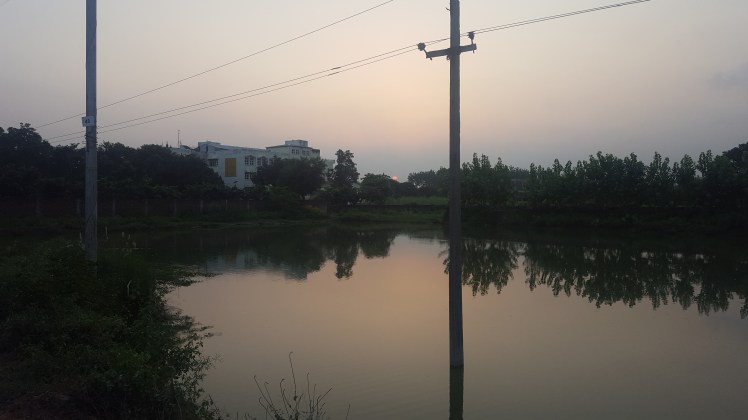
Camden had already spent months in Anupshahr at the Pardada Pardadi School getting to know the staff and students and visiting the surrounding villages. He knew what to expect, while I, on the other hand, had only my own imagination. We arrived at the gated campus community surrounded by sprawling farmlands to find girls of all ages in green and white and yellow uniforms playing all sorts of games between their classes. Despite no clear three-point line, baseline, or free-throw line, many girls spend their free time out on the sandy basketball court practicing their game and engaging in fierce but fun competition. Nearby, other girls were playing a game that looked like a variation of tag. It did not take long until Camden and I were recruited to join in on the sport. We settled in our rooms at the teacher’s colony, which is a three-story dorm-like building, fully accommodated to house numerous volunteers for any length of time. Each room is equipped with its own closet, western-style bathroom (i.e. no squat toilet), a powerful ceiling fan, and some larger rooms also have their own balconies. The roof provides a great spot to watch the sunset, and if you walk by the kitchen your nose will be pleasantly assailed by a symphony of Indian spices. Breakfast, lunch, and dinner are provided everyday by two very friendly women employed by PPES, there is a washing machine located next to the building, and if you need anything else, just ask Ramu…he’s the guy who knows how to get things around here.
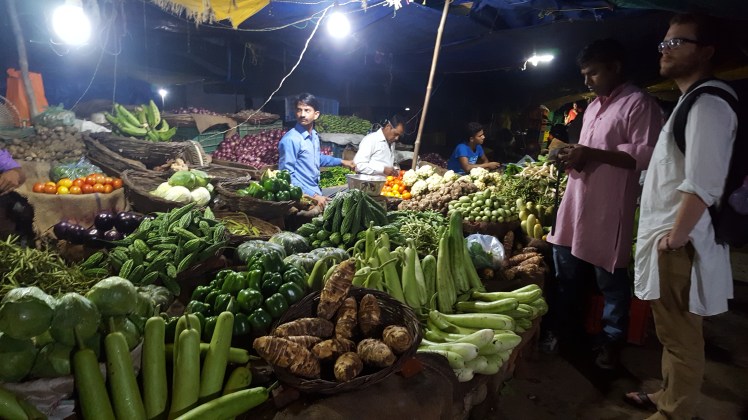
Camden gave me the tour of the teacher’s colony, the school, and the grounds. We then ventured our way into the town that we would call home for the upcoming months. The town essentially consists of one main road that is lined with street vendors selling everything from fruit to shoes to cooking appliances, all of whom seem very unfazed by the road’s many vehicles and their drivers’ inexplicable need to continuously blare their horns. We passed a small wooden shack where a barber was sculpting a man’s mustache with a straight razor with impressive speed and accuracy; we would later return to this shack as customers, leaving with matching mustaches and haircuts for a whopping total of 120 rupees (under two dollars US), including tip! As the sun was setting, my first ever straight-razor shave was performed under the light of Camden’s cellphone flashlight…now that is trust. If you continue along the main road, on the left there is a big tarp-covered vegetable market filled with vegetables of all different shapes, sizes, and colors. For every one vegetable I would recognize, there would be another five I had never seen before. As we continued past the market, the road got narrower and narrower. Despite the road’s ever decreasing width, the number of pedestrians, street vendors, cars, trucks, motorcycles, and rickshaws does not decline. Even though Anupshahr does not have nearly the same crowds and traffic as Delhi, a walk through town is anything but leisurely, albeit stimulating. Keep walking all the way down the road and you will reach a dead-end at Ganga, known as the Ganges River in English.
-Adam


So exciting! Great photos!! The mustaches are great!
LikeLike