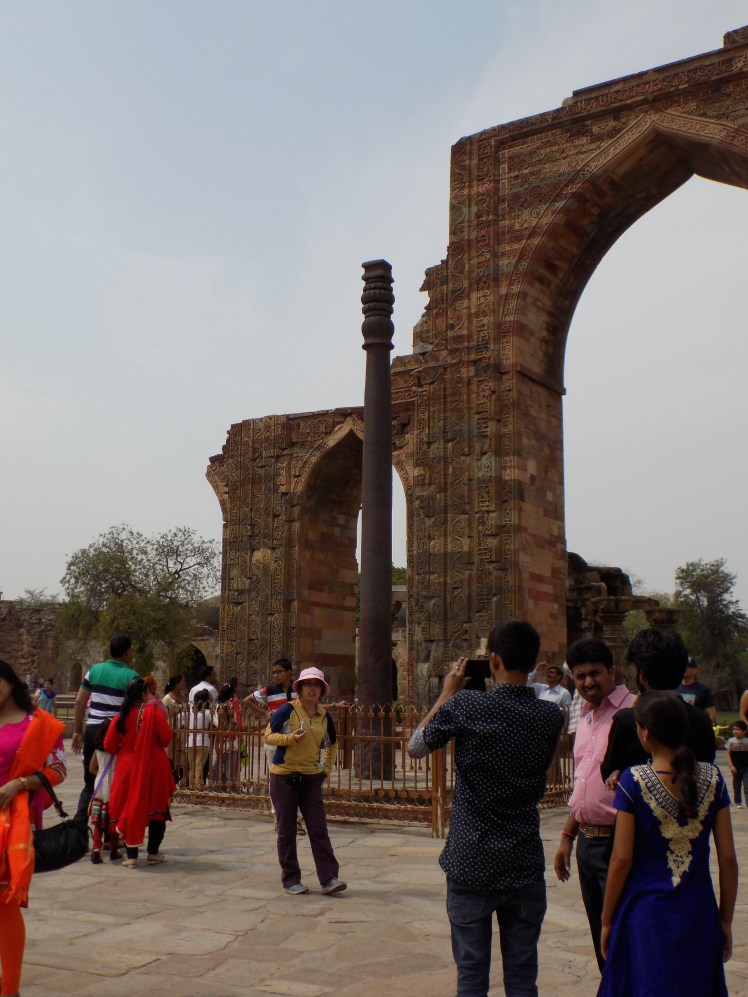
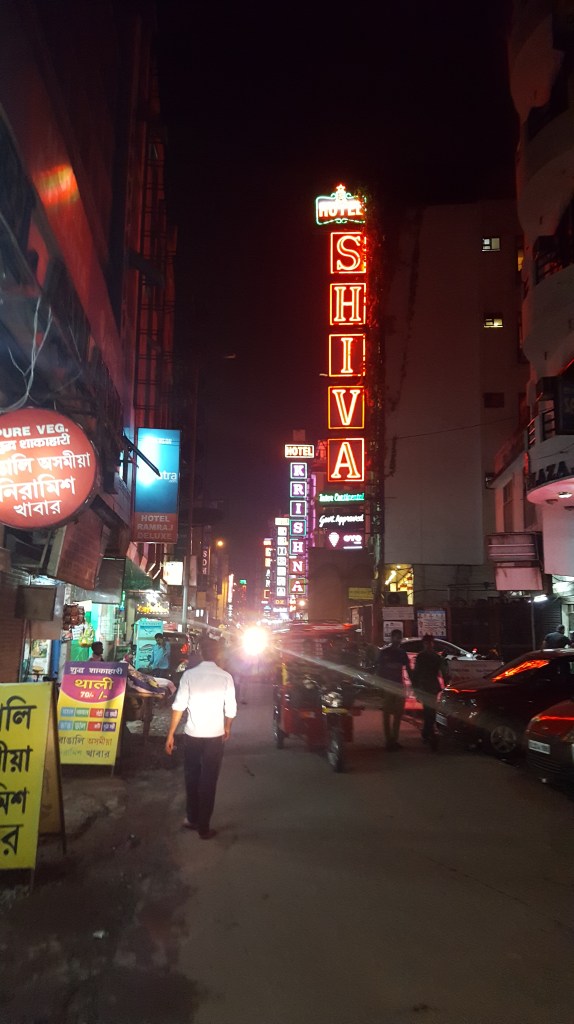
Delhi. What a city! During many years of travel, I have seen 27 countries and yet, there is still no place quite like Delhi. Delhi is an ancient city that has been the capital of many empires. Ashoka, the Hindu turned Buddhist emperor of India’s largest historical empire, left one of his many columns which dictated the rules and customs of his empire. The Mughals left the enormous Red Fort. The British built Connaught Place and New Delhi. Now, brilliant young software engineers and Indian and American companies are building the face of modern India in Gurgaon. That being said, the real essence of Delhi is in the crowded narrow streets of Old Delhi. The incredible smells of Punjabi kebabs and tandoori chicken distract you from the immanent danger of speeding rickshaws and the cacophony of horns that typify the old sections of town. Delhi overwhelms the senses. You either love it or you hate it, and I think it is fair to say that Adam and I love it.
-Camden
One of the most important aspects of our meeting with Vivek and co. at SELCO, was that they put us in touch with Boond Engineering & Development, a solar company similar to SELCO with offices in Delhi. While SELCO was happy to help us gather information and plan our project, they are based in Bangalore. Bangalore and Pardada Pardadi are about about 2,000 kilometers apart. To provide some perspective, that’s roughly the same distance between Washington D.C. and Dallas, Texas. Boond, however, is based in Delhi, which is slightly closer to Aupshahar than Bangalore (about 150 km). So we got ourselves to the Bangalore airport, choosing the 2.5-hour flight over the 40-hour train ride, and bid south India adieu.
After struggling with spotty Wi-Fi and no sim cards, we managed to successfully get an Uber from our hotel to Boond’s offices in Delhi. There we met Tarun Kalra, Boond’s COO. SELCO had expounded upon the benefits of home lighting systems, and we were pretty convinced that this was the route that our project should go. But Tarun and Boond had a different focus: the micro-grid. Surely, we thought, the micro-grid was too expensive and complex for our project, right? Wrong. In fact, not only did we learn that a micro-grid would be financially feasible, but the centralized system that Boond employs would be even easier for the villagers to use, maintain and control than that of individual home lighting systems. We kept our business faces on, but the excitement oozing out of us was palpable. Villages in Uttar Pradesh, Tarun said, provide an ideal layout for micro-grids. Each village forms a tight knit community that is separated from the neighboring villages by fields of rice, sugarcane, wheat, and mustard seed, to just name a few. The state of Uttar Pradesh, or UP for short, is slightly smaller than the state of Michigan by land area; while the population of UP is over 204 million people, and Michigan’s population is under 10 million. If UP was its own country, it would be tied with Brazil for the 5th most populous country in the world.
Through our meeting with Tarun, it became clear that it was time to seriously consider the micro-grid. We now had three possible models: the original solar lantern model, the home lighting system, and the micro-grid. We knew that deciding which model to pursue would probably be the biggest decision we would have to make. Talking had gotten us far, but in order to make a truly informed decision, it was time to see the systems in action. Tarun invited us to go visit Boond’s solar installations in Unnao, a town in central UP. With no verbal discussion between us necessary, Camden and I immediately accepted.
-Adam
 The Village Solar Project
Great travelogue and progress report. Keep up the great work! Looking forward to the next post.
Roger
LikeLiked by 1 person